Night Film Photography Guide — Low Light Film Stocks, Pushing Techniques, and Shooting After Dark in Louisville, Kentucky
TK Broecker / 28 June 2026
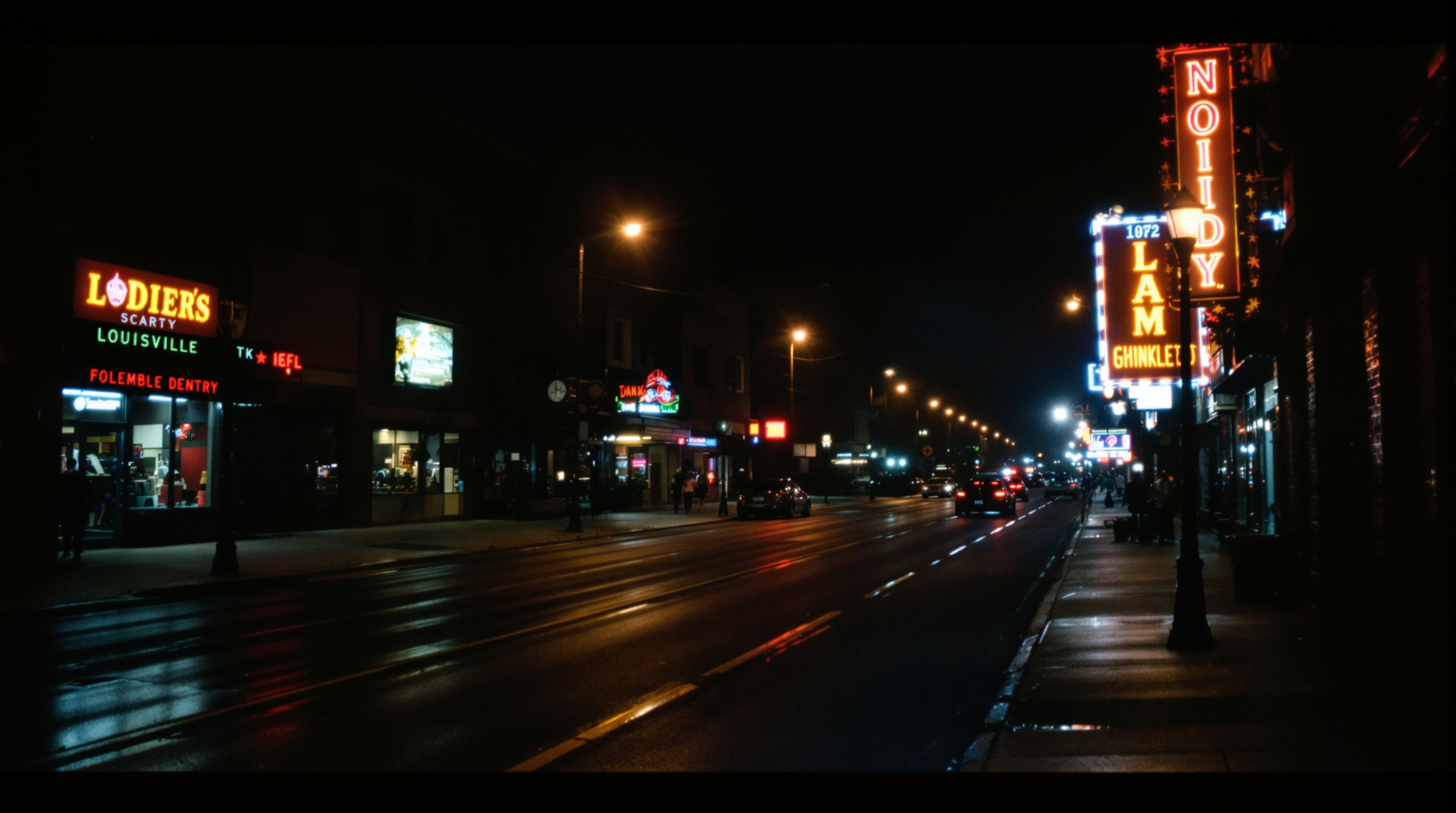
Shooting film after dark is one of the most rewarding — and technically demanding — challenges in analog photography. Unlike digital cameras, film doesn't let you dial in an ISO on the fly. Your choices happen before you load the camera. This guide walks through the best high-speed film stocks, how push processing works, and how to make the most of Louisville's rich nocturnal landscape on analog film.
Understanding High ISO Film Stocks for Low Light
Film speed, expressed as an ISO or ASA rating, determines how sensitive a film emulsion is to light. For night work, you need stocks rated at ISO 800 or higher to avoid impractically long exposures. The most widely discussed option is CineStill 800T, a cinema film (based on Kodak Vision3 500T motion picture stock) that has been made available in still-photography formats by removing its remjet anti-halation backing. This process creates the film's signature halation effect — glowing halos around bright light sources — which has become a stylistic hallmark of night film photography.
Key technical specs of CineStill 800T:
- Rated ISO: 800 (can be pushed to 1600 or 3200)
- Color balance: Tungsten (3200K), meaning it renders artificial street and indoor lighting neutrally, while daylight appears very blue
- Grain: Fine-to-medium — remarkably controlled for an 800-speed stock
- Process: C-41 (standard color negative chemistry), widely available in Louisville and nationwide
Other strong contenders for low light work include Kodak Ultramax 400 and Kodak Portra 400, both of which push reliably to 800 or 1600. For black-and-white shooters, Ilford Delta 3200 — natively rated at 3200 ISO — is considered the gold standard for extremely dim environments, offering fine grain relative to its speed thanks to its core-shell crystal technology. Kodak T-MAX P3200 is another native 3200 stock with excellent shadow detail when pushed.
Push Processing Explained — Getting More from Your Film
Push processing means deliberately underexposing your film (by shooting at a higher ISO than the stock's box speed) and then compensating during development by extending development time. Each stop of push approximately doubles the development time adjustment. For example, shooting CineStill 800T at ISO 1600 is a one-stop push; at ISO 3200 it is a two-stop push.
What pushing actually does is increase the development of shadow areas that received less light, boosting perceived contrast and apparent film speed. The trade-offs are:
- Increased grain: Shadow grain becomes noticeably more pronounced with each stop pushed
- Contrast increase: Highlights can block up; shadow separation can decrease
- Color shifts: On color negative film, pushing can cause slight shifts in color balance, often toward warmer or cooler tones depending on the stock
For night work in Louisville — whether you're shooting neon-lit bars on Bardstown Road, the glowing bridges over the Ohio River, or Churchill Downs under artificial lighting — a one-stop push (800T shot at 1600) typically gives you an excellent balance of speed and image quality. A two-stop push is viable but requires careful metering and acceptance of heavier grain.
Important: The entire roll must be shot at the same exposure index (EI), since development affects the whole roll equally. Mark your canister clearly before shooting.
Metering and Exposure Techniques for Night Analog Photography
Accurate metering at night is arguably the hardest part of film night photography. In-camera TTL meters and handheld reflective meters struggle with extreme contrast — bright streetlights against deep shadows can fool a meter into underexposing the overall scene. Recommended approaches include:
- Spot metering on midtones: Find a surface that is neither a direct light source nor pure shadow — a lit pavement, a person's skin, a building facade — and meter from that
- Incident metering: A handheld incident meter (like the Sekonic L-308 series) measures the light falling on your subject rather than reflected off it, giving a much more reliable exposure in high-contrast night scenes
- Expose for the shadows: With color negative film, which has a wide exposure latitude, it's often better to slightly overexpose to protect shadow detail. Color negative film handles overexposure better than underexposure
- Reciprocity failure: At exposures beyond roughly 1 second, film emulsions lose sensitivity non-linearly — a phenomenon called reciprocity failure. Each film has its own reciprocity characteristics; Kodak and Ilford publish correction tables. For CineStill 800T, exposures beyond 2–4 seconds may require adding 1/2 to 1 full stop of additional exposure
Practical Tips for Shooting Film at Night in Louisville
Louisville offers a compelling variety of nighttime shooting locations for film photographers. The NuLu arts district, Whiskey Row on Main Street, and the Big Four Bridge pedestrian walkway — which connects Louisville to Jeffersonville, Indiana — all provide dramatic artificial lighting, architectural interest, and atmospheric depth ideal for tungsten-balanced stocks like CineStill 800T.
Practical gear and workflow recommendations:
- Use a fast lens: A 50mm f/1.4 or f/1.8 is the minimum for handheld night work. At ISO 1600 (push-processed 800T) and f/1.8, you can expect shutter speeds of 1/30–1/60 sec under typical urban artificial lighting
- Carry a small tripod or gorilla pod: For longer exposures, even a lightweight travel tripod opens up exposure options significantly
- Shoot in short sessions and keep notes: Film doesn't give you instant feedback. Keep a small notebook or use a voice memo app to log your exposures — frame number, aperture, shutter speed, and any push notes
- Local lab processing: Louisville has reputable labs for C-41 and black-and-white processing. Always specify your push when dropping off — one stop push or two stops push must be communicated clearly to avoid normal development of a pushed roll
- Embrace the grain and halation: The halation halos and visible grain are not flaws in night film photography — they are part of the aesthetic language of the medium. Lean into them rather than fighting them
Conclusion
Night film photography rewards patience, technical preparation, and a willingness to embrace the unpredictable. By choosing the right high-speed stock — whether the cinematic warmth of CineStill 800T, the versatility of Kodak Portra 400 pushed to 800, or the extreme sensitivity of Ilford Delta 3200 — understanding push processing, and metering carefully, you can produce compelling, atmospheric images long after the sun goes down. Louisville's streets are waiting.