Instant Film vs 35mm Film in Louisville — A Complete Guide for Analog Photography Lovers
TK Broecker / 24 May 2026
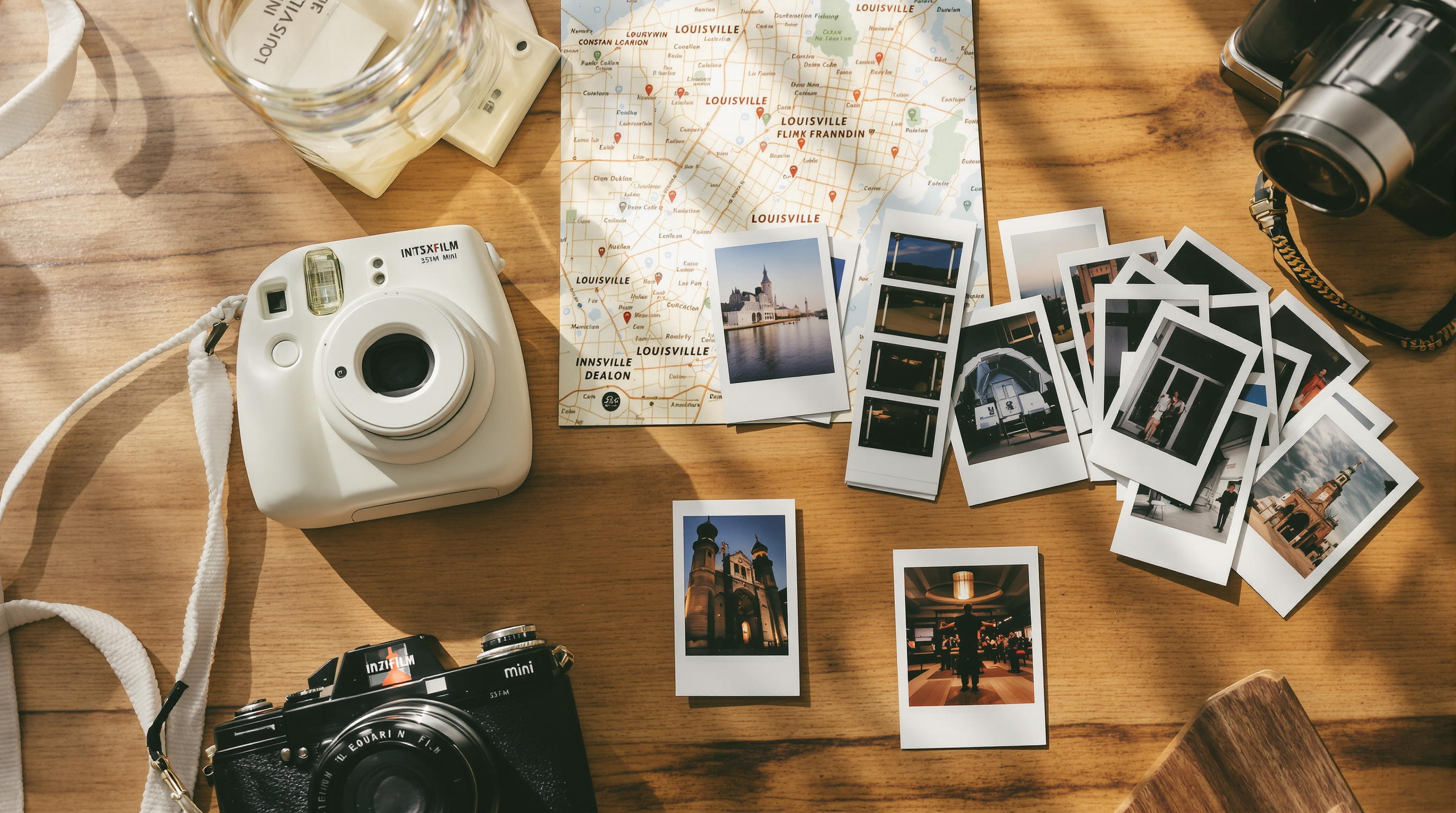
Whether you're strolling through Louisville's NuLu arts district or capturing a Derby Day memory, film photography offers something digital simply can't replicate — a tangible, chemical magic that makes every shot feel deliberate and alive. But with both instant film cameras (like the Fujifilm Instax series) and classic 35mm film cameras available, how do you choose the right one? This guide breaks down both formats so you can shoot with confidence.
What Is Instant Film Photography?
Instant film photography refers to a process where the film develops automatically and almost immediately after exposure — no darkroom, no lab, no waiting. The most popular instant film systems today are:
- Fujifilm Instax — Available in Mini (credit-card size), Square, and Wide formats. Instax film uses an integral film system where development chemicals are built into each film pack and activated by rollers inside the camera upon ejection.
- Polaroid Originals (Now1) — The spiritual successor to the original Polaroid instant cameras, using i-Type or 600 format integral film, producing the iconic square print with a white border.
Instant film is ISO 800 for most Instax Mini packs, making it reasonably sensitive to light. However, it tends to produce slightly overexposed results in bright outdoor settings if exposure compensation isn't applied. The chemistry behind instant film was pioneered by Edwin Land and Polaroid Corporation in 1948, and Fujifilm's Instax line — launched in 1998 in Japan — has since become the dominant consumer instant film product globally.
What Is 35mm Film Photography?
35mm film, also known as 135 format, is the most widely used photographic film format in history. It features a strip of film 35mm wide with sprocket holes along the edges, housed in a metal or plastic canister. When you shoot a roll, each frame is a negative that must be developed in a lab using chemical processes (C-41 for color negative film, E-6 for slide film, or D-76 for black-and-white).
In Louisville, Kentucky, several labs still process 35mm film, including local options and mail-in services. Popular 35mm film stocks include:
- Kodak Gold 200 — Warm tones, affordable, great for outdoor daylight shooting
- Kodak Ultramax 400 — Versatile, good indoor and outdoor performance
- Fujifilm Fujicolor C200 — Cooler, more neutral tones
- Ilford HP5 Plus 400 — Classic black-and-white, extremely versatile
- Kodak Portra 400/800 — Professional-grade, exceptional skin tones and dynamic range
35mm cameras range from fully manual SLRs like the Canon AE-1 or Pentax K1000 to compact point-and-shoots like the Olympus Stylus Epic (Mju-II), beloved for its sharp 35mm f/2.8 lens.
Instant Film vs 35mm — Key Differences
Understanding the core differences will help you decide which format suits your style and budget — especially if you're shooting around Louisville's vibrant scenes.
- Image Quality: 35mm film significantly outperforms instant film in resolution, dynamic range, and tonal depth. A well-exposed frame on Portra 400 scanned at high resolution can reveal extraordinary detail. Instax prints, by contrast, are small and slightly soft — but they carry an undeniable charm.
- Cost per Shot: Fujifilm Instax Mini film runs approximately $0.70–$1.00 per shot, while a roll of 36-exposure Kodak Gold 200 costs around $10–$12 with development adding another $10–$15. This makes both formats similarly priced per image, though 35mm gives you more control over your final cost depending on your lab.
- Immediacy: With instant film, you hold your photograph in seconds. With 35mm, you may wait days or even weeks — especially with mail-in labs. This waiting period is part of the romantic appeal for many photographers.
- Creative Control: 35mm cameras — particularly manual SLRs — offer full control over aperture, shutter speed, ISO choice (by selecting different film stocks), and focus. Most consumer instant cameras offer little to no manual control beyond basic exposure compensation.
- Portability and Social Use: Instax cameras are lightweight, fun, and produce print-ready physical photos instantly — perfect for parties, events, and travel. 35mm is slightly bulkier but more discreet with compact point-and-shoots.
- Archival and Shareable: 35mm negatives can be scanned and shared digitally, preserved long-term, and reprinted at any size. Instax prints are small physical objects that cannot be easily scaled or digitized without a dedicated scanner.
Which Format Should Louisville Photographers Choose?
For casual shooters, beginners, and social events — like Louisville's Churchill Downs, local weddings, or weekend farmers markets — an Instax Mini 12 or Instax Wide 300 is an excellent entry point. It's fun, immediate, and requires zero post-processing knowledge.
For serious hobbyists or those pursuing fine art analog photography, 35mm is unquestionably the richer format. Louisville's thriving art and creative scene makes it a great city to explore analog photography seriously, with access to local darkrooms and film communities.
If you're torn, consider this: start with Instax to fall in love with the tactile experience of film, then graduate to 35mm when you're ready to invest in craft. Many photographers in the Louisville analog community use both formats — Instax for spontaneous snapshots, 35mm for intentional photography.
Conclusion
Both instant film and 35mm photography offer irreplaceable experiences in a world dominated by digital images. Instant film delivers joy, immediacy, and tangible prints — perfect for social moments and beginners. 35mm film rewards patience, skill, and curiosity with superior image quality and creative freedom. In Louisville's rich creative landscape, there's room — and reason — to embrace both. Pick up a camera, load your film, and start shooting.